About PTFE Lined Static Mixers
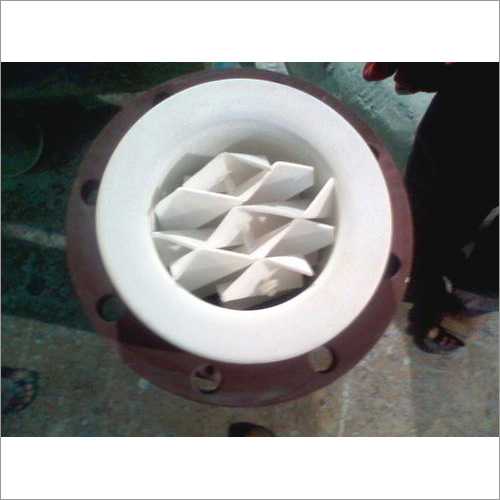
PTFE Lined Static Mixers are employed for applications where corrosive chemicals need to be mixed without corroding pipelines. These corrosion-resistant static mixers are required when mixing severe and aggressive chemicals. They are very easy to install as well as simple to use. These mixers require very low maintenance and replacement costs. PTFE-Lined Static Mixers are utilized to safeguard the purity of the products when processing resins and chemicals. These mixers are very economical and can be easily purchased by our eminent customers, at affordable prices, in bulk quantities.
Superior Chemical ResistanceThe PTFE lining provides outstanding protection against highly aggressive chemicals, minimizing corrosion and extending the lifespan of the mixer. This makes it ideal for handling acids, alkalis, and other challenging process fluids in demanding industrial environments.
Customizable to Process NeedsOur static mixers are available with variable numbers of mixing elements, customized dimensions, and capacity adjustments to precisely fit the requirements of your process line, ensuring efficient blending and homogenization regardless of fluid viscosity or flow rate.
Maintenance-Free OperationThe inline static mixer features no moving parts, eliminating common wear points. This design allows for effortless cleaning, lowers maintenance demand, and supports continuous operation-making it both cost-effective and reliable for long-term performance.
FAQ's of PTFE Lined Static Mixers:
Q: How do PTFE Lined Static Mixers achieve efficient mixing without moving parts?
A: PTFE Lined Static Mixers utilize internally fixed mixing elements that consistently divide, rotate, and recombine fluid streams as they flow through the device. This static mechanism ensures thorough mixing without requiring a shaft, external drive, or powered components.
Q: What kind of fluids and processes are PTFE Lined Static Mixers suitable for?
A: These mixers are engineered for the blending and homogenization of highly corrosive liquids, chemicals, and process media. Their applications include chemical processing, water treatment, pharmaceuticals, and petrochemicals-especially where chemical resistance and purity are critical.
Q: When should a process specify a PTFE lining thickness different from the standard 3 mm?
A: A thicker or custom PTFE lining may be specified when dealing with exceptionally corrosive substances, higher temperature conditions, or processes that demand extended service life. The lining thickness is tailored as per customer and process requirements.
Q: Where are the PTFE Lined Static Mixers typically installed within a process system?
A: These inline mixers are installed directly onto pipelines using flanged ends, allowing seamless integration into new or existing process lines. Location is usually chosen where thorough mixing or blending is essential for downstream operations.
Q: What is the process for certifying the quality of the PTFE lining?
A: Every mixer is supplied with a test certificate confirming the quality and properties of the PTFE material used in the lining. The lining process employs either isostatic or paste extrusion methods, ensuring uniform thickness and chemical compatibility.
Q: How does the maintenance-free feature benefit the user?
A: With no internal moving parts, there is minimal risk of mechanical failure or wear. Users benefit from reduced downtime, lower maintenance costs, and easy cleaning-making operations both cost-effective and reliable over extended periods.
Q: What are the packaging standards for shipping PTFE Lined Static Mixers?
A: Mixers are packed in sturdy wooden crates or export-standard packaging to ensure safe transport, preserve product integrity, and facilitate smooth delivery to domestic or international locations.


 Send Inquiry



 Send Inquiry


 Send Inquiry
 Send SMS


